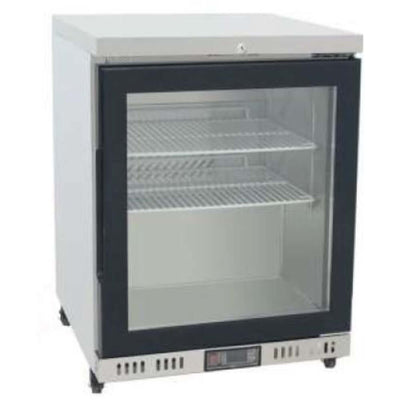
A commercial bar fridge comes down to five choices: width (how many doors), door style (hinged or sliding), glass or solid doors, a height and depth that fit your bar, and the ventilation it needs once it's in place. Get those right and the rest, such as lighting, locks and shelving, is mostly preference.
For a typical under-bar spot, single-door models in our range are about 600 mm wide, two-door models about 900 mm and three-door models about 1350 mm, with heights from about 785 mm to 900 mm. Wider back-bar coolers run from 1220 mm to 2540 mm. Most of the bar fridges we stock hold 2°C to 8°C.
The sections below work through each choice using real models from our commercial bar fridge range, so you can shortlist with the spec sheets in front of you.
Width: 1, 2 or 3 doors
Bar fridges are sold by door count, and door count sets the width. Measure the gap under or behind the bar, then choose the widest unit that still fits once you allow for its ventilation clearance (covered below).
| Size | Typical width | Capacity | Examples in our range |
|---|---|---|---|
| 1 door | 600 mm | 121–138 L | Atosa BB-138HEC (138 L), FED Thermaster LG-138TD (121 L), FED-X XR200SG (136 L) |
| 2 doors | 900 mm | 188–208 L | Atosa BB-208HEC and BB-208SEC (208 L), FED Thermaster LG-208TD (188 L) |
| 3 doors | 1350 mm | 293–330 L | Atosa BB-330HEC (330 L), FED Thermaster LG-330TD (293 L), FED Thermaster SC316SD (320 L gross) |
| Back-bar coolers | 1220–2540 mm | 315–852 L | Anvil BBZ0200 (2 doors, 1460 mm, 315 L) to BBZ0400 (4 doors, 2540 mm, 670 L); Atosa MBB90 (2268 mm, 852 L) |
Compare capacities carefully, because some listings quote gross volume and others net (usable) volume: the Thermaster SC316SD is 320 L gross but 222 L net. Shelf layout matters too. Most Thermaster coolers have two shelf levels plus the floor, while the Anvil BBZ back bars have a full-height door opening with no bottom step and 740 mm of internal height, so stock is easy to load and see.
Hinged or sliding doors
Hinged (swing) doors open up the whole compartment, which makes restocking quick. The catch is the space they swing into. Behind a narrow bar, an open door can block the walkway while someone is loading it.
Sliding doors stay within the fridge's own footprint, so they suit tight bar aisles. The trade-off is access: the doors slide past each other, so you can't open the whole front at once. Sliding-door models in our range include:
- Atosa BB-208SEC (two doors, 900 mm) and BB-330SEC (three doors, 1350 mm), the same widths as the hinged BB-208HEC and BB-330HEC
- FED Thermaster LG-208SC and LG-330SC under-bench coolers
- FED Thermaster SC248SD and SC316SD, with double-glazed, lockable doors
If you go with hinged doors, check which way they open. The Anvil BBZ back bars have self-closing glass doors that are fully reversible, so the hinge side can suit your layout.

The Atosa BB-330SEC triple sliding door bar fridge is 1350 mm wide and 835 mm high, with 330 litres of capacity behind double-glazed doors.
Glass or solid doors
Glass doors let customers see what's on offer and let staff spot what needs restocking without opening the fridge. Many of the glass-door bar fridges we stock are double-glazed. In humid venues, look at heated glass: the FED Thermaster LG-208TD heated glass door bar fridge and its single and triple-door siblings have tropicalised heated glass doors with a heater switch, designed to stop condensation fogging the glass.
Solid doors suit back-of-house storage, or a bar where you'd rather keep stock out of sight. Some models come in both versions, such as the FED-X XR200SG (glass door, 136 L) and XR200SS (solid door, 130 L gross). Read both spec sheets, because ratings can differ within a pair: the glass-door XR200SG is rated for a 25°C room, the solid-door XR200SS for 30°C.
Height and depth: will it fit under the bar?
An under-bar fridge has to clear the underside of the counter. Heights in our range include:
- 785 mm: Atosa MBC24 chiller cabinets, 605 mm wide
- 835 mm: the Atosa BB series and the FED Thermaster LG-TD series
- 850 mm: FED-X XR200 bar fridges
- 860–900 mm: Anvil BBZ back bars, 900 mm on their removable castors or 860 mm on the optional legs
- 880–900 mm: FED Thermaster SC series, 900 mm on castors and 880 mm without; Thermaster lists them as suitable for under-bench use once the castors are removed
- 1055–1068 mm: Atosa MBB back-bar coolers, which stand taller; the MBB69 and MBB90 have a stainless steel top
Depth matters as much as height. The Atosa BB and Thermaster LG-TD models are about 520–530 mm deep, the Anvil BBZ and Thermaster SC316SD 535 mm, the FED-X XR200 585 mm and the Atosa MBB back bars about 714 mm. Allow for the handle, the power lead and the ventilation gap before you decide it fits.
Our tip: Measure the under-bar opening (height, width and depth) and subtract the ventilation clearance the spec sheet asks for before you compare models. Then measure the aisle behind the bar: if it's narrower than one fridge door is wide, sliding doors will be easier to work with.
Ventilation for built-in installs
A bar fridge moves heat out through its condenser, so it needs air. Boxed into joinery with no gaps, it has to work harder to hold temperature. Follow the clearance on the spec sheet: the FED Thermaster bar coolers, for example, require 100 mm of wall clearance for ventilation, and the Anvil BBZ back bars have an easily accessible condenser filter to keep clean.
Some undercounter kitchen fridges, such as the Polaris T25 range, are designed to breathe from the front, with front air intake and exhaust, which suits fitting them under an existing bench. The bar fridge listings in our range don't describe a front-breathing design, so if your joinery will enclose the sides and back, plan for the stated clearance or ask us before you order.
Also check the ambient rating, which is the hottest room the fridge is designed to work in. Ratings in our bar range run from 25°C (FED-X XR200SG) and 32°C (most Thermaster models) up to 38–42°C for the Anvil BBZ and Atosa BB series and 43°C for the Atosa MBB48G and MBB59G back bars. The space under a busy bar can run warmer than the rest of the room, so allow some margin.
Temperature: beer, mixers and wine
Most of the bar fridges we stock, including the FED Thermaster and Anvil models, hold 2°C to 8°C. The Atosa MBB69 and MBB90 back bars hold 0°C to +10°C, and the FED-X XR200 models -2°C to +8°C.
If the fridge also holds milk, cream or other potentially hazardous food, set it so that food stays at 5°C or below, in line with the FSANZ food safety standards. A digital controller with a temperature read-out, which most models in our range have, makes that easy to check at a glance.
Wine is a different job. Dedicated wine fridges work in warmer bands: the Atosa SC-145 WD is an under-bench dual-zone model (upper zone 4–12°C, lower zone 12–22°C, up to 46 bottles, 820–870 mm adjustable height), and the FED Thermaster WB-24H is a 430 mm wide single-zone unit holding +5°C to +18°C. See our commercial wine fridges if wine is a big part of your list.
Lighting, locks and other features
- Lighting: LED lighting on every door of the Anvil BBZ, LED interior lighting on the Atosa MBB69 and MBB90, and internal lights on the Atosa BB series and the Thermaster coolers.
- Locks: door locks are standard on most models, including the Thermaster, Anvil, Atosa MBB and FED-X ranges, which helps when the bar is unattended.
- Self-closing doors: fitted to the Thermaster and Anvil ranges, so a door left slightly open swings shut.
- Shelving: fully adjustable shelves on the Thermaster coolers, and two anti-tipping shelves per door on the Anvil BBZ.
Bar freezers for frozen stock
If you need frozen storage behind the bar, our bar freezers come in similar footprints:
- FED-X XF200SG (glass door, 114 L, -18°C to -15°C) and XF200SS (solid door, 108 L gross, -22°C to -18°C), both 600 mm wide and 850 mm high, running from a 10 A plug
- Atosa MBC24F and MBC24FG freezer cabinets, 605 mm wide and 785 mm high
- FED Thermaster DC-80F, an 80 L bar/undercounter freezer with three baskets, holding -18°C to -10°C
The FED-X freezers use static cooling and need regular manual defrosting, and so does the DC-80F, so plan a time for it. For a steady supply of ice, look at commercial ice machines rather than a freezer.
Power and getting it in
Bar fridges draw modest power. The FED Thermaster LG-TD range is listed at 165–235 W and the SC316SD at 140 W, all on a standard 10 A plug, and the FED-X bar fridges and freezers also run from a 10 A plug. Even the four-door Anvil BBZ0400 is listed at 0.456 kW.
The bigger issue is usually the number of power points. A bar with two or three fridges, a glasswasher and an ice machine needs an outlet for each. Don't run them from double adaptors or extension leads; have a licensed electrician add outlets and check that the switchboard has the capacity.
Back-bar coolers are also heavy: the Anvil BBZ0400 weighs 151 kg. Standard delivery is by tailgate truck to the front of your premises, so plan how you'll move it inside, or request delivery inside the front door when you order (an extra fee applies). Check that it fits through every doorway on the way in.
Frequently asked questions
What size bar fridge do I need?
Start with the space: about 600 mm wide for one door, 900 mm for two and 1350 mm for three in our under-bar range. Within that width, compare net (usable) capacity and shelf layout rather than the headline litres.
Can a bar fridge go under the counter?
Yes, if the height fits and it gets the ventilation its spec sheet asks for. Heights in our range start at 785 mm, and several Thermaster models drop to 880 mm with the castors removed. Leave the stated clearance, which is 100 mm of wall clearance for the Thermaster range.
Are sliding doors better for a small bar?
Often, yes. Sliding doors don't swing into the aisle, so staff can get past while someone restocks. You can't open the whole front at once, though, so hinged doors can be quicker to load where there's room.
What temperature should a bar fridge be set at?
Most models in our range hold 2–8°C. If you store milk, cream or other potentially hazardous food in it, keep that food at 5°C or below.
Do bar fridges need a special power point?
The models with power details listed, such as the FED Thermaster LG-TD and FED-X ranges, run from a standard 10 A plug. Give each one its own outlet.
Compare sizes and door styles across our bar fridges, along with bar freezers and wine fridges. For help matching a model to your bar's measurements, send us a product question, or request a quote for a full bar fit-out.