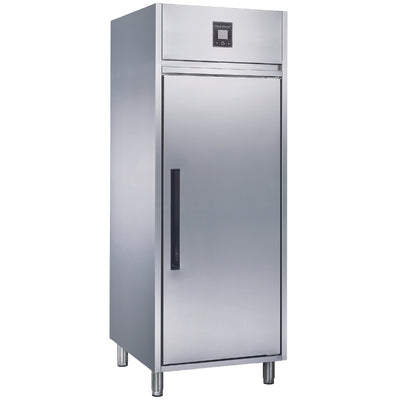
A commercial fridge runs 24 hours a day, every day of the year, so small differences in energy use add up to real money over the years you own it. This guide shows you how to work out what a fridge or freezer costs to run, what's typical for each type, and practical ways to bring the power bill down.
Work out your running costs
Enter the fridge's energy use and your electricity rate. To see what a more efficient model would save, tap "Compare with a second fridge".
How to work out a fridge's running cost
The sum is simple:
Energy use (kWh per 24 hours) x your electricity rate x 365 days = running cost per year
For example, the Thermaster BC3100G three door drink cooler is listed at 3.796 kWh per 24 hours. At 35 cents per kWh, that's about $1.33 a day, or around $485 a year.
Where to find the energy use
Look for a figure in kWh per 24 hours on the spec sheet or energy label. Commercial fridges and freezers sold in Australia are registered under the Greenhouse and Energy Minimum Standards (GEMS) scheme with their tested energy use, and many of our product pages show it under "Energy use".
If you only know the watts
The power rating in watts is how much the fridge draws while it's running. Fridges switch on and off to hold their temperature, so they don't draw that power all day. Multiply the watts by the hours a day it actually runs, then divide by 1,000 to get kWh. It's only a rough estimate, so use the kWh figure whenever you can.
Your electricity rate
Your power bill shows the usage rate in cents per kWh. Business rates vary by state, retailer and plan, so use your own. If your plan has peak and off-peak rates, use an average, because a fridge runs day and night.
Typical running costs by type of fridge
These figures come from the published energy use of the fridges and freezers in our range, from the smallest model to the largest, costed at 35 cents per kWh.
| Type | Energy use (kWh per 24 hours) | Cost to run per year |
|---|---|---|
| Bar fridges | 0.6 to 4.7 | $82 to $602 |
| Underbench fridges | 0.4 to 5.0 | $47 to $639 |
| Upright fridges | 1.2 to 11.5 | $150 to $1,464 |
| Countertop display fridges | 2.3 to 3.8 | $293 to $479 |
| Cake and food display fridges | 4.4 to 30.9 | $557 to $3,950 |
| Glass door multideck fridges | 5.9 to 10.7 | $750 to $1,360 |
| Open multideck fridges | 15.8 to 31.2 | $2,024 to $3,986 |
| Chest freezers | 1.1 to 4.4 | $146 to $560 |
| Underbench freezers | 1.3 to 9.1 | $160 to $1,159 |
| Upright and display freezers | 6.2 to 39.4 | $792 to $5,035 |
| Gelato display freezers | 3.2 to 5.2 | $409 to $668 |
These are tested figures. A fridge in a hot kitchen, with doors opening all day, will use more.
Why two similar fridges can cost very different amounts
Open front vs glass doors
This is the biggest difference of all. An open multideck keeps the cold in with a curtain of moving air, and some of that cold spills out all the time. In our range, the Thermaster OC-1220 open multideck (1280mm wide) is listed at 20.11 kWh per 24 hours, while the Saltas MDS1250 glass door multideck (1310mm wide) is listed at 5.87 kWh. At 35 cents per kWh, that's about $2,569 a year against $750, a difference of around $1,800 a year, or about $9,000 over five years. Open fronts make it easy for customers to grab and go, but if a glass door model suits your shop, it costs far less to run.
Glass doors vs solid doors
Glass lets more heat in than an insulated solid door, so a glass door display fridge usually uses more power than a solid door storage fridge of a similar size. If the fridge is out the back where customers don't see it, solid doors make sense.
Fridges vs freezers
A freezer holds a much bigger temperature difference to the room than a fridge does, so it works harder and costs more to run. Display freezers with glass doors use the most.
Size
Bigger cabinets use more power, but a big fridge that sits half empty wastes money too. Choose the size that suits what you actually stock.
Room temperature
The hotter the room, the harder a fridge has to work. Check the maximum room temperature a fridge is rated for, and choose one rated well above the temperatures your shop or kitchen reaches in summer.
Energy ratings
Commercial fridges and freezers sold in Australia must meet minimum energy performance standards under GEMS. Star ratings for commercial cabinets are voluntary, so not every supplier shows one. Where a fridge has a star rating, more stars mean less energy for its type and size, and we show it on the product page when the supplier provides it. For comparing running costs, the kWh per 24 hours figure is the most useful, because it plugs straight into the calculator above.
8 ways to cut your fridge running costs
- Put it in the right spot. Keep fridges away from ovens, fryers, dishwashers and direct sun, and leave the ventilation gap around the cabinet that the manual asks for. A fridge that can't get rid of its heat works harder.
- Keep the condenser clean. Dust and grease on the condenser make the fridge work harder. Clean it as often as the manual recommends, or have a licensed refrigeration technician do it.
- Check the door seals. Close the door on a sheet of paper. If it pulls out easily, cold air is escaping there. Clean the seals regularly, and replace any that are torn or flattened.
- Set the right temperature. Cold food should be kept at 5°C or colder, but setting a fridge much colder than it needs to be just uses more power.
- Keep doors closed and air moving. Restock in one go rather than in lots of small trips, make sure doors close properly, and don't block the internal air vents with stock.
- Close up open displays at night. If your open multideck has a night blind, pull it down when the shop is closed.
- Switch off what you don't need. If a second drinks fridge sits idle in the quiet season, empty it, clean it and switch it off, leaving the door slightly open so it stays fresh.
- Compare before you replace. When an old fridge is due for replacement, use the calculator to compare its running cost with a newer model. A saving of 2 kWh a day is worth about $256 a year at 35 cents per kWh, or almost $1,300 over five years.
Running cost FAQs
How much does it cost to run a commercial fridge?
It depends on the type and size. At 35 cents per kWh, the fridges and freezers in our range cost from under $100 a year for the smallest bar fridges to around $4,000 a year for large open multidecks, and more for the biggest display freezers. Use the calculator above with your fridge's energy use and your own rate.
Do glass door fridges use more power?
Usually, yes. Glass lets in more heat than an insulated solid door. Open-front fridges with no doors use much more again.
Is it worth paying more for an energy-efficient fridge?
Often, because a fridge runs every hour of the day for many years. Put both models into the calculator's compare option to see the yearly saving, then weigh it against the difference in price.
Does a fridge cost more to run in summer?
Yes. A hotter room means the fridge runs for longer to hold its temperature, so expect higher power use in the warmer months.