To clean a stainless steel bench or sink, wash it with water and a mild detergent using a soft cloth or soft brush, wiping along the grain. Rinse with plenty of water, then dry with a soft absorbent cloth so streaks don't form. On surfaces that touch food, sanitise after cleaning. Done regularly, that routine is most of the job.
What you keep away from the steel matters just as much: steel wool, bleach, hydrochloric acid, chloride-based or harsh powder cleaners and metal scrapers. And if a bench shows rust spots, the cause is usually ordinary (carbon) steel that has touched it, not the stainless itself.
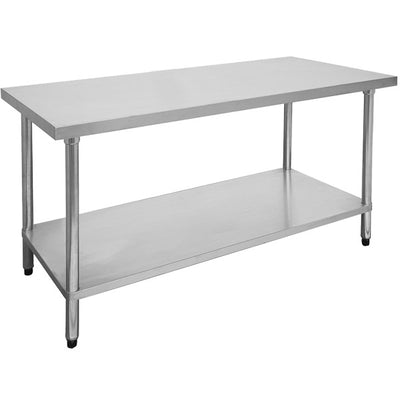
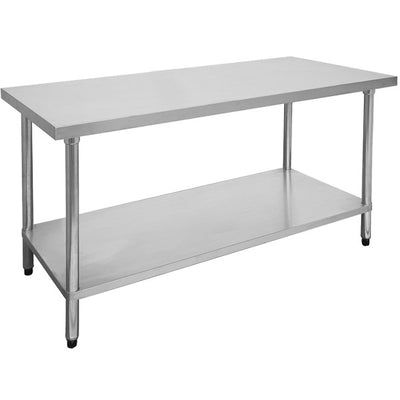
This guide follows the cleaning advice of the Australian Stainless Steel Development Association (ASSDA). It applies to stainless steel work benches, sink benches, wall shelves and undershelves.
The everyday routine
- Clear the surface. Lift equipment and containers off rather than dragging them, because grit trapped underneath scratches the steel.
- Wash with water and a mild detergent on a cloth or soft brush, working along the grain.
- Rinse with plenty of clean water. A quick wipe with a damp cloth tends to smear dirt around rather than remove it.
- Dry with a soft absorbent cloth, so water doesn't leave streaks.
Why "with the grain" matters
Look closely at a bench top and you'll often see fine polish lines running one way. That is the grain of a brushed finish. Wipe and scrub along those lines, never across them. Rubbing across the grain spoils the finish, and it can create tiny crevices where dirt collects and corrosion may start.
Labels and spills
- Peel off sticky labels promptly. Leftover glue collects grime.
- Don't leave salt, acids or salty and acidic foods, such as brine, marinades or citrus juice, sitting on the steel for long periods. They can discolour it.
Sanitising food-contact surfaces
Under the Food Standards Code (Standard 3.2.2), food-contact surfaces of equipment must be kept clean and, where they touch food, in a sanitary condition. In practice that means two steps:
- Clean first, using the routine above, to remove food and grease.
- Then sanitise with a food-safe sanitiser, used as the label directs.
If your sanitiser is chlorine-based, follow the label's dilution and contact time, and rinse or wipe as the label says. Don't leave it pooling on the steel. ASSDA advises against using bleach as a cleaner on stainless, because it is easy to over-concentrate and hard to rinse off.
Stain by stain: what to use
For marks the everyday routine doesn't shift, here is ASSDA's advice for indoor stainless steel, mark by mark. Start with the gentlest option.
| Mark | What to use | Afterwards |
|---|---|---|
| Fingerprints, oil and grease | Glass cleaner on a soft cloth, or methylated spirits or alcohol | Rinse and dry |
| Tea and coffee rings | Soak with boiling water mixed with baking powder | Rinse well and dry |
| Hard-water scale | Soak with hot water and vinegar | Rinse and dry |
| Rust spots | Cream cleanser on a soft damp cloth. If that fails, a proprietary stainless steel cleaner. These often contain phosphoric or oxalic acid, so handle them with care. | Neutralise as the product directs, then rinse and dry |
| Stubborn marks | A clean nylon scourer, or a cloth with a chalk-based cream cleaner. Test a hidden spot first, as it can leave a polished patch. | Rinse and dry |
| Burnt-on food (heavy jobs) | A stainless steel wool pad, accepting that it will scratch | Rinse and dry |
Two kinds of "tea staining"
Rings left by cups of tea or coffee are a simple cleaning job (see the table). But in the stainless steel industry, "tea staining" also means something else: a brown, cosmetic surface corrosion. It is mostly an outdoor and coastal problem and rare indoors. It doesn't affect the steel's strength or life, and regular cleaning prevents it. So on an indoor kitchen bench, treat brown spots as rust spots first.
Why rust spots appear on stainless steel
Rust spots on stainless are usually a sign of contact with carbon (ordinary) steel. The common sources are:
- steel wool (wire wool), which leaves tiny fragments behind;
- a scourer that has been used on ordinary steel;
- cast iron pans and steel tools left sitting on a wet bench.
Those fragments rust on the surface, and it looks as though the stainless is rusting. Remove the spots with the method in the table, then remove the cause: keep carbon steel items off stainless, especially when wet, or the spots will come back.
Our tip: Keep one clean nylon scourer just for your stainless benches and sinks, and store it away from the steel wool and the cast iron pans. A scourer that has touched ordinary steel can leave fragments that rust on the bench.
What not to use: do and don't
| Don't | Why | Do instead |
|---|---|---|
| Steel wool, or scourers used on ordinary steel | Fragments left behind rust on the surface | A clean nylon scourer. Keep stainless steel wool pads for heavy jobs like burnt-on food, as they scratch. |
| Bleach | Easy to over-concentrate and hard to rinse off | Mild detergent to clean, then a food-safe sanitiser used as the label directs |
| Hydrochloric acid, including brick and masonry cleaners that contain it | On ASSDA's list of cleaners to avoid on stainless | Hot water and vinegar for scale; a proprietary stainless steel cleaner for rust spots |
| Chloride-based or harsh powder cleaners | ASSDA advises avoiding them on stainless | Mild detergent, or a chalk-based cream cleaner for stubborn marks (test first) |
| Metal scrapers, or dragging rough items across the top | They scratch, and so does grit trapped under objects | Lift items off; use a soft brush or a clean nylon scourer |
| Rubbing across the grain | Spoils the finish and creates crevices where dirt collects | Wipe along the polish lines |
| A quick wipe with a damp cloth, then leaving it wet | Smears dirt and leaves streaks | Rinse with plenty of water and dry with a soft cloth |
If tiles or brickwork near your benches are being cleaned with a masonry cleaner that contains hydrochloric acid, cover the stainless first and rinse off any splashes straight away.
Why 304 grade matters in wet areas
The care routine is the same for every grade, but some grades cope better with water and chemicals than others:
- 304 contains about 18% chromium and 8% nickel, which is why it's also called 18/8. It is more corrosion-resistant and the usual choice for wet areas and food contact.
- 430 is a ferritic grade with no nickel. It is cheaper and less corrosion-resistant, and suits dry areas.
- 201 is a lower-nickel grade sometimes used to cut cost.
- 316 is a higher grade sometimes specified near the coast. ASSDA notes it copes with more chlorine than 304.
Around sinks, dishwasher benches and anything that is often wet, a 304 surface gives you more margin if a spill or chemical is left a little too long. Check the product page for the grade. For example, the Modular Systems SMS-H mop sink is 1.2 mm 304 (18/8) stainless with a hairline finish and a fully welded bowl polished inside and out.
Galvanised undershelves and legs on economic benches
Not every part of a "stainless" bench is stainless. Modular Systems economic benches, such as the 0600-6-WBB 600 × 600 mm workbench, have a 1.2 mm 304-grade stainless top with a 100 mm splashback, but the undershelf and legs are galvanised steel. The stainless advice in this guide applies to the top and splashback.
Mixrite benches in our range have a 1.2 mm stainless top on round stainless steel tube legs with adjustable stainless feet. If you're not sure which parts of your bench are stainless, ask us.

The Mixrite SS1606 sink bench is 600 × 600 mm, with a fabricated 450 × 450 × 300 mm bowl and a 150 mm splashback.
Sinks, shelves and the gaps between equipment
- Sink benches: for hard-water scale, use the hot water and vinegar soak, then rinse and dry well so the vinegar isn't left on the steel.
- Mop sinks: floor cleaners can end up sitting in the bowl. Rinse it with plenty of water after you empty the bucket, especially if your floor cleaner is bleach- or chloride-based.
- Stainless wall shelves and undershelves: the same wash, rinse and dry routine applies.
- Gaps: a narrow gap between a bench and the next piece of equipment is hard to reach with a cloth. An infill bench such as the Mixrite WTS703B 300 mm infill bench fills it, so food and grime can't collect there.
Frequently asked questions
Can I use bleach on stainless steel benches?
ASSDA advises against bleach as a cleaner, because it's easy to over-concentrate and hard to rinse off. Clean with a mild detergent. If your food-safe sanitiser is chlorine-based, follow the label's dilution, contact time and rinsing directions, and don't let it pool.
Why is my stainless steel bench rusting?
Usually it isn't the bench itself. Rust spots generally come from carbon steel that has touched it, such as steel wool fragments or a cast iron pan left on a wet bench. Start with a cream cleanser on a soft damp cloth.
Can I use steel wool on stainless steel?
Not ordinary steel wool. Its fragments rust on the surface. Stainless steel wool pads are acceptable for heavy jobs such as burnt-on food, but they will scratch.
Is vinegar safe on stainless steel?
Yes, as a soak with hot water to remove hard-water scale, as long as you rinse and dry afterwards. Don't leave acids, including vinegar, sitting on the steel for long periods.
What does 18/8 stainless steel mean?
It refers to 304-grade stainless, which contains about 18% chromium and 8% nickel. It's the usual choice for sinks, wet areas and food contact.
Browse our stainless steel benches, sink benches and wall shelves. If you have a question about a grade or finish, ask us about a product, or request a quote for a full fit-out.