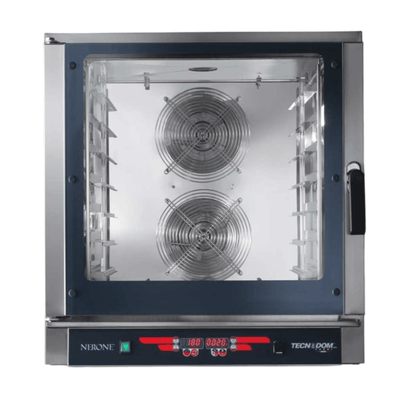
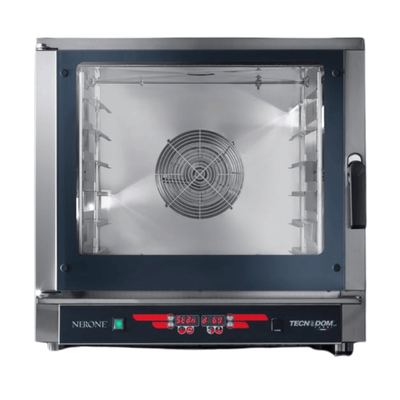
A commercial combi oven cooks with dry, fan-forced heat, with steam, or with both at once. One oven can roast, bake, steam and reheat, jobs that would otherwise need a convection oven and a separate steamer. For cafés, restaurants, clubs and caterers, that flexibility is the main reason to buy one.
To choose the right model, work through four decisions in order: size (how many GN 1/1 or GN 2/1 trays you need in the oven at your busiest time), fuel (electric or gas, based on what your site can supply), steam system (boiler or boilerless) and controls (manual or touchscreen). Then have your licensed electrician, plumber and, for gas, gasfitter confirm the site has the power, water, drain and ventilation the oven needs.
The examples below come from the commercial combi ovens in our range, from compact 6-tray units to 20-tray floor models.
What a combi oven does that a convection oven can't
A convection oven circulates hot, dry air with a fan. It roasts and bakes well, but it can't steam. A combi adds a steam system and humidity control to the same fan-forced chamber, giving you three modes:
- Convection: dry heat for roasting, baking and browning, from 30°C to 300°C on the Fagor iKore and Lainox ranges.
- Steam: for vegetables, seafood, rice and dumplings. Fagor lists low-temperature steam from 30°C to 98°C, steam at 99°C and "super steam" from 100°C to 130°C.
- Combination: heat and steam together, with the oven managing chamber humidity. Fagor's iClima system measures humidity with a sensor and can also dehumidify the chamber for crisp roasts.
Most combis also have a core temperature probe, so you cook to the food's internal temperature instead of by the clock.
If your menu is mostly baking, reheating and simple roasting, a commercial convection oven may do the job for less, with a simpler installation. If you steam regularly, cook large proteins or want one oven to cover several jobs, a combi earns its place.
Sizing: tray count, GN 1/1 vs GN 2/1, and covers
Combi capacity is stated as the number of Gastronorm (GN) trays the oven holds.
- GN 1/1 pans measure 530 × 325 mm, the standard full-size pan.
- GN 2/1 pans measure 650 × 530 mm, the same area as two GN 1/1 pans side by side. That's why the 10 × GN 2/1 Lainox Naboo NAE102B is also listed as 20 × GN 1/1. GN 2/1 ovens suit caterers, clubs and bulk roasting.
- 600 × 400 mm bakery trays fit many combis, including the Tecnodom range, the Lainox Naboo range and the Atosa GN 2/1 models.
Size for your busiest hour, not an average day: count the trays that need to be in at once during peak service. Atosa's rough meals-per-service guide for its ovens is a useful starting point:
| Oven size | Typical fit | Atosa's guide (meals per service) | Examples in our range |
|---|---|---|---|
| Compact: 6 × GN 2/3 to 10 × GN 1/1, about 510–530 mm wide | Small kitchens short on space | Not stated | Lainox Compact Naboo COEN026B, Fagor iKore Kompact K-AW-061ESWR |
| 5–7 × GN 1/1 | Cafés and small restaurants | 20–80 (5 tray), 30–120 (7 tray) | Atosa EPC-0511E1, Tecnodom TD-6NE, Lainox Sapiens SAE061B |
| 10 × GN 1/1 | Busy restaurants, pubs and clubs | 80–150 | Atosa EPC-1011E2, Fagor CW-101ERSWS, Lainox NAE101B |
| 6–10 × GN 2/1 | Caterers, functions, bulk roasting | 60–160 (6 tray), 150–300 (10 tray) | Atosa EPC-0621E2, Atosa EPC-1021E3, Lainox SAE102B |
| 20 × GN 1/1 or GN 2/1 | Large-scale production | Not stated | Fagor CW-201ERSWS, Lainox NAE201B, Lainox NAE202B |
Footprint matters too: the Lainox Compact range is 510 mm wide and the Fagor Kompact 530 mm, against 852 mm for a 6-tray Lainox Naboo. Check the door hinge side as well, since the Fagor Kompact can be ordered left- or right-hinged.

The Fagor iKore Kompact Advance K-AW-061ESWR fits 6 × GN 1/1 trays into a 530 mm wide cabinet.
Electric vs gas combi ovens
Electric
Most combis in our range are electric, and all of those run on three-phase power (400–415 V), from 5.8 kW for the compact Lainox COEN026B to 73.2 kW for a 20 × GN 2/1 Lainox. As a guide to circuit size, Atosa specifies a 20 A circuit breaker for its 5-tray EPC-0511E1 (10.1 kW), 40 A for the 10-tray EPC-1011E2 and 63 A for the 10 × GN 2/1 EPC-1021E3. If you don't have three-phase power, or your switchboard is already busy, talk to a licensed electrician before you buy.
Gas
Gas makes sense where it's already on site and electrical capacity is limited. Our gas models are the Fagor iKore Advance APW-101GRLWS 10-tray gas combi oven, rated at 64.8 MJ/h, and the 20-tray APW-201GRLWS at 129.6 MJ/h. Both are supplied for natural gas, with LPG available on request, and both still need an electrical connection (0.83 kW at 10 A and 1.55 kW at 15 A respectively).
Gas appliances must be certified for use in Australia and installed by a licensed gasfitter to AS/NZS 5601.1. Give your gasfitter the MJ/h figure so they can check your supply, meter and pipework.
Boiler vs boilerless (direct injection) steam
| Boiler (steam generator) | Boilerless (direct injection) | |
|---|---|---|
| How steam is made | A separate generator makes steam and feeds it into the chamber | Water is sprayed onto the fan or heating element |
| Main strength | Strong, consistent steam | Simpler and cheaper to run |
| Upkeep | The generator needs descaling | No separate generator to look after |
| Examples in our range | Fagor iKore Concept PureSteam (CPW) and iKore Advance (APW); Lainox Naboo boiler versions to order | Fagor iKore Concept (CW) and Kompact; Lainox Naboo, Sapiens and Compact |
A boiler can add to the price. In the Fagor iKore Concept range, the 6-tray PureSteam boiler model is about $2,100 more than the matching direct-injection model (ex GST, at the time of writing, October 2026). As a rule of thumb, a boiler suits kitchens that steam heavily all day, such as banqueting or high-volume seafood and vegetables. Boilerless suits most cafés and restaurants that mainly roast, bake and use combination mode.
Either way, water quality matters. Water treatment is commonly recommended to stop scale, and manufacturers often make it a warranty condition. Fagor's PureSteam listings state the warranty is void without the correct water filtration installed and in use, while Lainox ovens come with a 5 micron water filter. Check the warranty terms before you order.
Controls, programs and self-cleaning
Manual and programmable controls suit experienced chefs who like to set the oven themselves, and they tend to be quicker to learn. The Fagor iKore Concept uses a 2.8 inch screen with a rotary knob and 100 preset recipes. The Lainox Sapiens stores up to 99 programs of up to 9 cycles, with a USB port for HACCP downloads.
Touchscreens suit kitchens with rotating staff or several sites, where every tray needs to come out the same. The Fagor iKore Advance has a 10.1 inch touchscreen with smart cooking processes that adjust as food cooks. The Lainox Naboo links to the Nabook cloud for recipes, remote HACCP and energy monitoring.
Automatic cleaning is standard on most combis in our range, from Atosa's five cleaning modes plus descaling to Lainox's Vapour Cleaning System and the 4-stage wash on the Tecnodom Nerone CL. Check whether your oven uses solid or liquid detergent and budget for it as a running cost.
Installation: power, water, drain, exhaust and water treatment
We supply the oven; installation must be done by licensed trades. Check the spec sheet against your site with them before you order:
- Power: a licensed electrician confirms supply and switchboard capacity and installs the circuit.
- Gas: a licensed gasfitter, working to AS/NZS 5601.1.
- Water and drain: combis need a cold water supply and a drain, connected by a licensed plumber. Atosa, for example, specifies a 1/2 inch feed at 2–3 bar.
- Water treatment: fit what the manufacturer specifies, and check the warranty terms.
- Exhaust: most commercial cooking set-ups need a mechanical exhaust hood, with requirements set by building rules and AS 1668.2. Check with your council and a ventilation specialist, and see our commercial exhaust hoods. Fagor's condensing hoods sit on top of iKore 061 and 101 ovens to capture steam and can save fitting a full canopy, subject to local requirements.
- Access: the Atosa 10 × GN 2/1 model weighs 197.6 kg, so measure doorways and corridors before delivery.
Our tip: Have your plumber fit the water filter or treatment the manufacturer specifies at the same time as the water connection, not as a later job. That way the oven is protected from scale, and your warranty conditions are met, from the first day of cooking.
Stands, stacking and loading trolleys
Bench-top combis (generally 6 and 10 tray) usually sit on a stand made for the model, which sets a comfortable working height and adds tray storage underneath. The Fagor SH-BK85-Kompact gives an 850 mm working height, sits on castors and holds 9 × GN 1/1 pans.
Stacking saves floor space and lets you cook at two temperatures at once. Fagor stacking kits mount a 6-tray iKORE electric oven on a 10-tray or another 6-tray; the column is assembled at the factory, so order the kit with both ovens. The Lainox Naboo NAE161B 6 + 10 tray stacked combi puts two ovens in one unit, 1840 mm tall, so think about who will reach the top shelf.
20-tray combis are floor-standing and can be loaded with a mobile trolley. Fagor's CEB-201 holds 20 × GN 1/1 pans, so you load it away from the oven and wheel the whole rack in. A combi also pairs naturally with a blast chiller for cook-chill: cook in batches, chill quickly and store safely until service.
Frequently asked questions
Do I need three-phase power for a commercial combi oven?
For the electric models in our range, yes. Without three-phase, look at gas: the Fagor gas combis list an electrical rating of only 0.83 kW (10 A) or 1.55 kW (15 A), plus a gas supply checked by your gasfitter.
Does a combi oven need a water filter?
Water treatment is commonly recommended to prevent scale, and many warranties depend on it, so check the terms for your model. Lainox ovens come with a 5 micron filter.
Does a combi oven need an exhaust hood?
Usually. Most commercial cooking set-ups need mechanical exhaust under building rules and AS 1668.2. A condensing hood made for your model may reduce what's needed, subject to local requirements, so check with your council.
What size combi oven does a café need?
For most cafés, a 5–7 tray GN 1/1 model or a compact oven around 510–530 mm wide is the place to start. Atosa puts its 5-tray model at around 20–80 meals per service.
How much does a commercial combi oven cost?
In our range, roughly $5,800–$22,000 for 5–8 tray models, $8,500–$31,000 for 10 × GN 1/1 models and $32,000–$61,500 for 20-tray models (ex GST, at the time of writing, October 2026). Boiler and gas models sit toward the top of each band. Stands and hoods are sold separately, and installation by your licensed trades is a separate cost.
Compare sizes, steam systems and controls in our full combi oven range. If you're weighing up two models or want to check one suits your site, ask us about a specific model or request a quote, including stands, stacking kits and condensing hoods.