A blast chiller does a job a fridge or freezer isn't built for: it pulls freshly cooked food down from cooking temperature to fridge temperature quickly. A storage fridge or freezer is designed to keep food that is already cold at a steady temperature. Load it with hot food and it struggles, and the rest of the cabinet warms up too.
That speed matters because Australian food safety rules set a deadline. Cooked potentially hazardous food must cool from 60°C to 21°C within 2 hours, then from 21°C to 5°C within a further 4 hours. A blast chiller makes meeting that a routine step, and most models in our range can also shock freeze food to -18°C for longer storage.
To choose one, start with the kilograms you need to chill per cycle, then look at tray count, reach-in or roll-in format, power and placement. The examples below come from our blast chiller and shock freezer range.
Why a fridge or freezer can't cool hot food fast enough
Fridges and freezers are holding cabinets. Their refrigeration is sized to keep cold food cold through normal door openings, not to strip a large amount of heat out of trays of hot food. Put a deep pan of hot stew in a storage fridge and three things happen:
- The centre of the food cools slowly, even when the surface feels cold.
- The cabinet temperature rises, putting the other food inside at risk of going above 5°C.
- The fridge runs hard and may still not get the food through the cooling window in time.
A freezer isn't the answer either. It is still a storage cabinet, just a colder one.
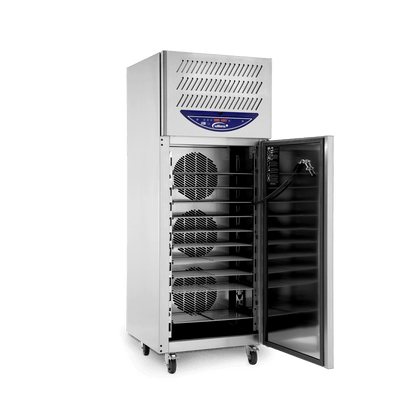
A blast chiller is designed for that load. Fans drive cold air over and around the trays for a fast, even temperature drop, and a core probe in the food tells the controller the temperature at the centre, not just the air temperature.
The FSANZ 2-hour/4-hour cooling rule
Food Standards Australia New Zealand (FSANZ) Standard 3.2.2 sets the temperature rules food businesses work to:
- Keep potentially hazardous food at 5°C or below, or 60°C or above.
- Cool cooked potentially hazardous food from 60°C to 21°C within 2 hours.
- Then cool it from 21°C to 5°C within a further 4 hours.
Standard 3.2.2A also applies to many food service and retail businesses that handle unpackaged potentially hazardous food. It requires food safety supervisors and food handler training, and some businesses must keep records of key controls such as temperature control. Check with your local council, or read the standards on the FSANZ website.
A blast chiller helps on both counts. It gets food through the cooling window quickly, and models with data logging make records easier. The Polaris Target Smart range has a USB port for HACCP data, for example, and the Lainox Neo range connects to Lainox's Nabook kitchen management cloud.
Blast chilling vs shock freezing
Most units in our range do both, and you choose the cycle for each batch.
| Blast chilling | Shock freezing | Storage freezer | |
|---|---|---|---|
| What it does | Brings hot food down to fridge temperature | Brings hot food down to frozen | Keeps already-frozen food frozen |
| Typical rated cycle | Core +90°C to +3°C | Core +90°C to -18°C | Not designed for hot food |
| Example load (Everlasting BCE2010, 10 tray) | 47 kg per cycle | 35 kg per cycle | Not applicable |
| Afterwards | Store at 5°C or below | Store frozen | Not applicable |
| Suits | Cook-chill for upcoming services | Batch cooking for longer storage | Holding frozen stock |
Freezing capacity is usually lower than chilling capacity in the same cabinet. The Polaris PTS121L, for instance, chills 45 kg but freezes 30 kg per cycle, although the Polaris GC roll-ins are rated the same for both. Some models go much colder: the Tecnodom DO range can shock freeze down to -40°C.
Tecnodom and Thermaster also say fast chilling helps food keep its colour and flavour.
Core probes and cycle types
Probe or timed cycles
Some units, such as the Everlasting range, run a cycle by core probe or by time. With a probe cycle, you put the probe into the thickest piece of food and the cycle ends when the centre reaches the target. Timed cycles suit thin items that are hard to probe. Everlasting units also switch to storage mode when the cycle ends, so food stays cold if it isn't unloaded straight away.
Hard and soft cycles
Everlasting units offer hard and soft cycles for both chilling and freezing: hard for dense foods such as roasts and braises, soft for delicate items such as pastries and cooked vegetables.
Multifunction models
Multifunction units heat as well as cool. The Polaris Genius GL10 multifunction blast chiller works across -40°C to +85°C. It can thaw, prove, hold, cook at low temperature, regenerate and temper chocolate, and combine heating and cooling phases in one program. The Lainox Neo CombiFreeze range can thaw, prove, slow cook up to 85°C and dry, and is designed to run 24 hours a day. These suit bakeries, pastry kitchens and production kitchens that want to cook overnight and chill automatically.
Sizing: kilograms per cycle first, then trays
Tray count tells you how many pans fit. Kilograms per cycle tells you how much food the unit can bring down in one go, and it's the better guide. Two 5-tray units in our range are rated at 25 kg (Everlasting BCE0005) and 30 kg (Polaris Genius GL05), while the 6-tray Polaris PQ61 is rated at 20 kg.
| Model | Format | Trays | Chill per cycle (+90°C to +3°C) | Freeze per cycle (+90°C to -18°C) | Power |
|---|---|---|---|---|---|
| Everlasting BCE0004 | Reach-in | 4 × GN 1/1 | 10 kg | 7 kg | 240 V, 0.67 kW |
| Polaris PQ61 | Reach-in | 6 × GN 1/1 | 20 kg | 11 kg | 240 V single phase, 0.88 kW |
| Everlasting BCE0005 | Reach-in | 5 × GN 1/1 or 600 × 400 | 25 kg | 18 kg | 240 V, 1.2 kW |
| Everlasting BCE2010 | Reach-in | 10 × GN 1/1 or 600 × 400 | 47 kg | 35 kg | 240 V, 1.6 kW |
| Polaris PTS161L | Reach-in | 16 × GN 1/1 | 68 kg | 45 kg | 400 V three phase, 4.74 kW |
| Everlasting BCE2020 | Reach-in | 20 × GN 1/1 or 600 × 400 | 82 kg | 65 kg | 400 V three phase, 4.1 kW |
| Polaris KC100C | Roll-in | One 20 × GN 1/1 trolley | 90 kg | 65 kg | 400 V three phase, 6.25 kW |
| Everlasting BCE9320 | Roll-in | One 20-tray trolley | 120 kg | 90 kg | 400 V three phase, 7.6 kW |
To size a unit:
- Find your largest batch in kilograms. If it's 25 kg of braised beef, the Everlasting BCE0005 handles it in one cycle; the 10 kg BCE0004 would need three.
- Count cycles per day. A smaller unit running cycles back to back may be enough. Check the rated cycle time on the spec sheet.
- Compare like with like. Tecnodom quotes chilling from +65°C rather than +90°C, so its figures aren't directly comparable.
- Check your trays. Make sure your pans fit (GN 1/1, 600 × 400 or, on the countertop Thermaster D-GT3, GN 2/3), and note any pan depth in the rating. The Thermaster D14 is specified for trays 40 mm deep.
- Check the ambient rating. The Everlasting BCE0004 is rated for rooms up to 32°C, while the BCE2020 and Atosa's EBF models are rated to 43°C.

The Everlasting BCE0005 5-tray blast chiller chills 25 kg from 90°C to 3°C per cycle on 240 V.
Reach-in vs roll-in blast chillers
Reach-in
Reach-in units take trays on runners. They range from the countertop Thermaster D-GT3 (33 litres, 10 A plug) through undercounter models such as the Atosa EBF-05 to tall uprights. The Tecnodom DO20 20-tray blast chiller freezes 70 kg from 90°C to -18°C in 180 minutes and still runs from a 10 A power point.
Roll-in
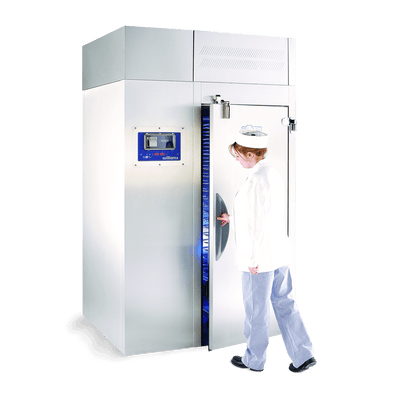
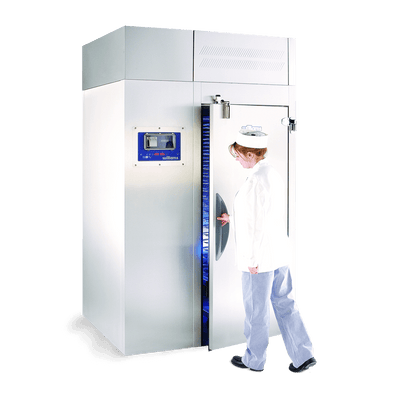
Roll-in units take a whole loaded trolley, so there's no transferring trays one by one. They suit large-scale production, especially alongside a trolley-loaded 20-tray combi (check trolley compatibility with both manufacturers).
- The Polaris KC100C roll-in blast chiller is self-contained, with the refrigeration unit on board, and arrives assembled. The trolley and ramp are sold separately.
- The Polaris GC101 to GC401 take one to four trolleys (80–320 kg per cycle), run from a remote condensing unit sold separately and are assembled on site.
- The Everlasting BCE9320 chills 120 kg per cycle from a remote condensing unit, installed by a licensed electrician and a licensed refrigeration technician.
How blast chillers support a cook-chill workflow
- Prep ahead: cook in quiet periods, chill, store at 5°C or below, then regenerate for service, for example in one of our combi ovens.
- Less waste: chill in portions and reheat only what each service needs, rather than hot-holding large trays.
- Consistency: the same recipe and chilling program every time, with probe readings to support your food safety records.
- Free up the chiller: move chilled food to an upright fridge or cool room so the blast chiller is ready for the next batch.
Our tip: Size your blast chiller for the biggest batch you cook at one time, not your daily total. Food waiting for a free cycle is food sitting warm, which is exactly what a blast chiller is meant to prevent.
Placement and ventilation
- Location: between the cooking line and cold storage, so hot trays don't travel far.
- Airflow: air-cooled condensers need clear airflow. Don't box the unit into a tight cupboard, and check the clearances on the spec sheet.
- Heat: match the ambient rating to the spot. Tecnodom's DO3EA, DO5EA and DO10EA are tropicalised (climate class 4) for hot kitchens.
- Drainage: those Tecnodom models and the Thermaster range have a self-evaporating condensate drain. Check what your chosen model needs.
- Power: use a suitable outlet, not a double adaptor or extension lead. Three-phase models must be connected by a licensed electrician.
Frequently asked questions
Can you put hot food straight into a blast chiller?
Yes, that's what it's for. Polaris and Everlasting rate their chilling loads from +90°C. Check the manual for your model's limits.
How long does a blast chiller take?
It depends on the load, the food and the pan depth. The Tecnodom DO20, for example, freezes 70 kg from 90°C to -18°C in 180 minutes. Check the rated cycle time on the spec sheet, and use a probe to confirm you've met the 2-hour/4-hour rule.
Can a blast chiller be used as a normal fridge or freezer?
Some hold food at temperature after a cycle, but they're designed for chilling. Move food to a storage fridge or freezer so the chiller is free for the next batch.
Do blast chillers need three-phase power?
Not always. The Tecnodom DO series and Thermaster D-G7 and D-GT3 run from a 10 A plug, and several Polaris and Everlasting models use 240 V. Larger units, such as the Polaris PTS161L and Everlasting BCE2020, need three-phase.
How much does a blast chiller cost?
In our range, roughly $3,000–$16,000 for 3–6 tray models, $6,000–$25,000 for 7–12 tray models and $10,000–$26,000 for 14–20 tray uprights, with multifunction models at the top of each band. Roll-ins start at about $37,000 or are price on application. All ex GST, at the time of writing (October 2026).
Compare sizes, cycle types and power options across our blast chillers. If you're not sure which size suits your batches, ask us about a model or get a quote, including for roll-in units.